

Misuse Your Tools
Nurture your ambition, not your gear collection.
I named this essay series DIY Golems because of my conviction that all good stories are golems - mystical facsimiles of human beings, there to guide and protect and assist. Today I want to focus on that first word - DIY - and why I think it’s just as important. Let’s talk a little bit about working with what you have and taking the ‘I need an Arri Alexa and a grip truck’ shackles off our minds.
Everyone knows failure is often our greatest teacher. I’m here to argue something slightly different:
It’s when you misuse your tools that you really get to know them.
Here’s a story that’s been told other places, in other ways:
In 1973, DJ Kool Herc was playing a party at 1520 Sedgwick Ave in the Bronx. He wasn’t a trained musician, couldn’t play the drums. He just had a few turntables, there to transition from one song into the next.
Instead, Kool Herc used those two turntables to extend a single scrap of music - the break from James Brown’s GIVE IT UP OR TURNIT A LOOSE - for minutes at a time, a continuous loop people could dance to, sing over, or rap on top of. They went nuts.
That was the day DJ Kool Herc invented Hip-hop.
Rather than simply following the package directions, using those turntables the way they were designed to be used, Kool Herc went about things the wrong way. In the process, he didn’t just learn more about the capabilities and functionality of the turntable - he invented a whole new art-form.
I think it’s our responsibility to do exactly that. To take our tools, what we have, and push them in strange, unexpected directions. Hip-hop should be required study for all artists because of exactly this quality - it’s a form about reinvention, about using whatever you have and know, even if you have very little. It’s the exemplar of DIY art in America1.
I went through a brief2 period where I thought I’d become a Hip-hop producer, and it was in no small part because of my deep love for sampling3. If all you have is someone else’s record, how do you take a few seconds of it and recontextualize them - put them in new places, tweak them, surround them with new sounds - until you create something original?
It turns out you don’t need to know how to read music to become a great musician. You don’t even need to own an instrument. So why can’t people who don’t have Final Draft write screenplays on Microsoft Word? Why can’t people shoot whole movies on iPhones? Why can’t we all just dive in, rather than worrying about whether we’ve got the right tools?
What I’m saying, really, is that your lack of tools does not, in any way, mean you lack the opportunity to make something interesting.
I am, as mentioned, a massive fan of Paul Thomas Anderson’s THE MASTER, and I think constantly about the fact that it was shot on, of all formats, 65mm.
65mm is a giant format, often used for sweeping vistas and stunning landscapes4. Instead, THE MASTER uses it mainly to show us close-ups of faces.
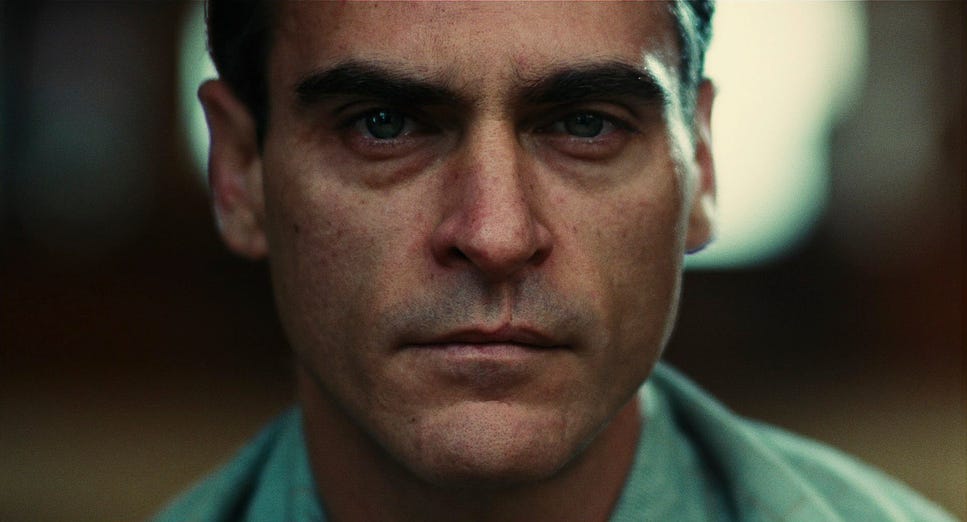
What’s more, the camera is big, noisy, tough to lug around. That only makes it even more intriguing that Anderson chose to stick it right up in the faces of his actors5.
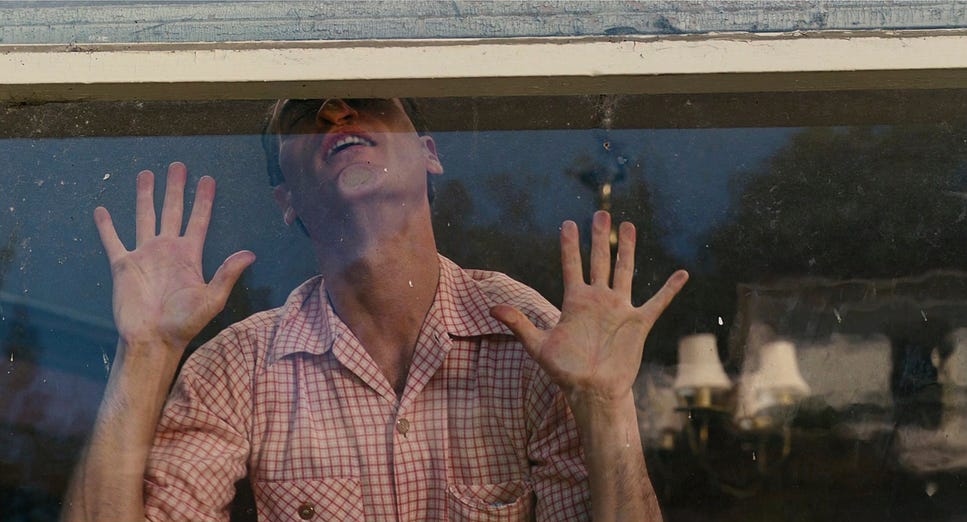
This is blatantly not how you’re ‘supposed’ to use this technology. And that’s probably why I find it incredibly inspiring.
On the one hand, that approach is a crystal-clear statement of the movie’s interests. You think the draw here is some big glorious wide shot? Not a chance, it’s Joaquin Phoenix and Phillip Seymour Hoffman and Amy Adams and Jesse Plemons and Laura Dern and Rami Malek and Madisen Beaty. That’s the good stuff.
But I also think THE MASTER is a perfect illustration of how you can create something new by using the tools you have6 in the wrong way. I don’t just mean that you can make a movie without a million-dollar grip package - any inspiring essay on the internet will say that. I mean that if you do it with a $20 set of lights from Home Depot, you’ll learn more about lighting and maybe find a new approach all your own.
I won’t pretend to be a brilliant photographer, but I do really enjoy taking portraits.
So? My tools:
I have a camera, I have an old vintage lens I bought on eBay7. The one thing I don’t have is photo editing software. Photoshop, Lightroom, all those fancy tools people use to actually color and finish their photos - none of ‘em.
What I do have is Final Cut Pro. So…I edit photos in video editing software.

I’m not arguing my photos are ‘better’ than they would have been had I edited them in Lightroom. I’m arguing that I’m better for having done it that way. I understand the capabilities of Final Cut because I’ve tried to stretch it in directions it’s not actually meant to go. I understand color and photography better because I’ve had to think about exactly what I want to achieve, and how to get there without toggling a preset slider.
Work-arounds, I’m saying, are really our greatest teachers.
You don’t need the nicest 35mm camera in the world, or the lenses that Gordon Willis shot THE GODFATHER on or some special LUT or software8. You don’t need this tool or that tool. You can take the tools you have, and try to push them towards your purposes - especially if they’re not tools custom-built for those purposes. Stop worrying whether you have the right thing to make something. Instead, try to stretch what you have towards what you’re making.
Shoot your film on projector lenses. Build a sequence around pinhole photography. Maybe your whole film is composed of stills like LA JETÉE.

Nourish your ambition, I’m saying, not your gear collection. Make what you want to make - don’t make what your tools are ‘right’ for. And if you can? Make sure to use those tools for whatever they’re wrong for.
In the process, you’ll learn a lot about those tools. But you’ll also learn a lot about the art-form itself. Limitations are good for art - pushing up against them is even better. Misusing your tools is a way to ensure you and your limitations are cheek to cheek.
I’m not the first to point out this is true of the African-American experience overall, or of Black Art in America. Here’s Jay-Z on WHAT’S FREE: “We started without food in our mouth / They gave us pork and pig intestines / Shit you discarded that we ingested, we made the project a wave”.
And embarrassing!
When I read THE WASTE LAND for the first time, I realized that TS Eliot was, essentially, sampling - taking scraps of Shakespeare and popular songs he didn’t write and turning them into something new.
BEN-HUR, for instance, was shot on 65mm.
“‘There might have been a little bit of eye rolling from them once in a while,’ Anderson said.” - The LA Times
Obviously, ‘the tools you have’ is not, for most of us, a 65mm camera from golden age Hollywood!
I opened that package up like someone fedexed me the holy grail, only to then go ‘oh, yeah…I guess I need an adapter to actually use this’.
This last one is a particularly pernicious internet scam. ‘Your movie will look great if you pay for my special film emulation LUT’ is a great way of getting your attention away from the image, what you’re trying to say with it, and the qualities of your actual work.