

Magic Over Math
Why Boston City Hall is both ugly and inspiring.
When I declared my English major, the department gave all of us a bookmark that read, in chintzy little font:
‘I’m an English major, you do the math’.
I’ve long since lost it. But I’ve started to suspect that was some sort of Zen koan.
Writing isn’t math. You can’t just follow rules. If there even are rules, it’s probably our job to break them.
I’ve often compared screenwriting to architecture - it’s not a novel, someone has to go build that fucker. You have to think practically. You can’t write something without the budget and time to realize it. You can write a woman with pearl earrings and Chanel coats - but someone has to have that on set in two days.
In my head, at least, here’s the difference between construction and architecture, and the reason the latter, like screenwriting, is an art:
There’s a right place to put a load-bearing wall. There might even be a few right places! But there’s not a right way for a building to look.
I grew up in a small town outside Boston and, once a year, my friends and I would attend the Scooper Bowl - an all-you-can-eat ice cream extravaganza / cancer fundraiser that takes place in the orthogonal shadow of what I maintain is one of America’s ugliest buildings.
Ladies and gentlemen…Boston City Hall:
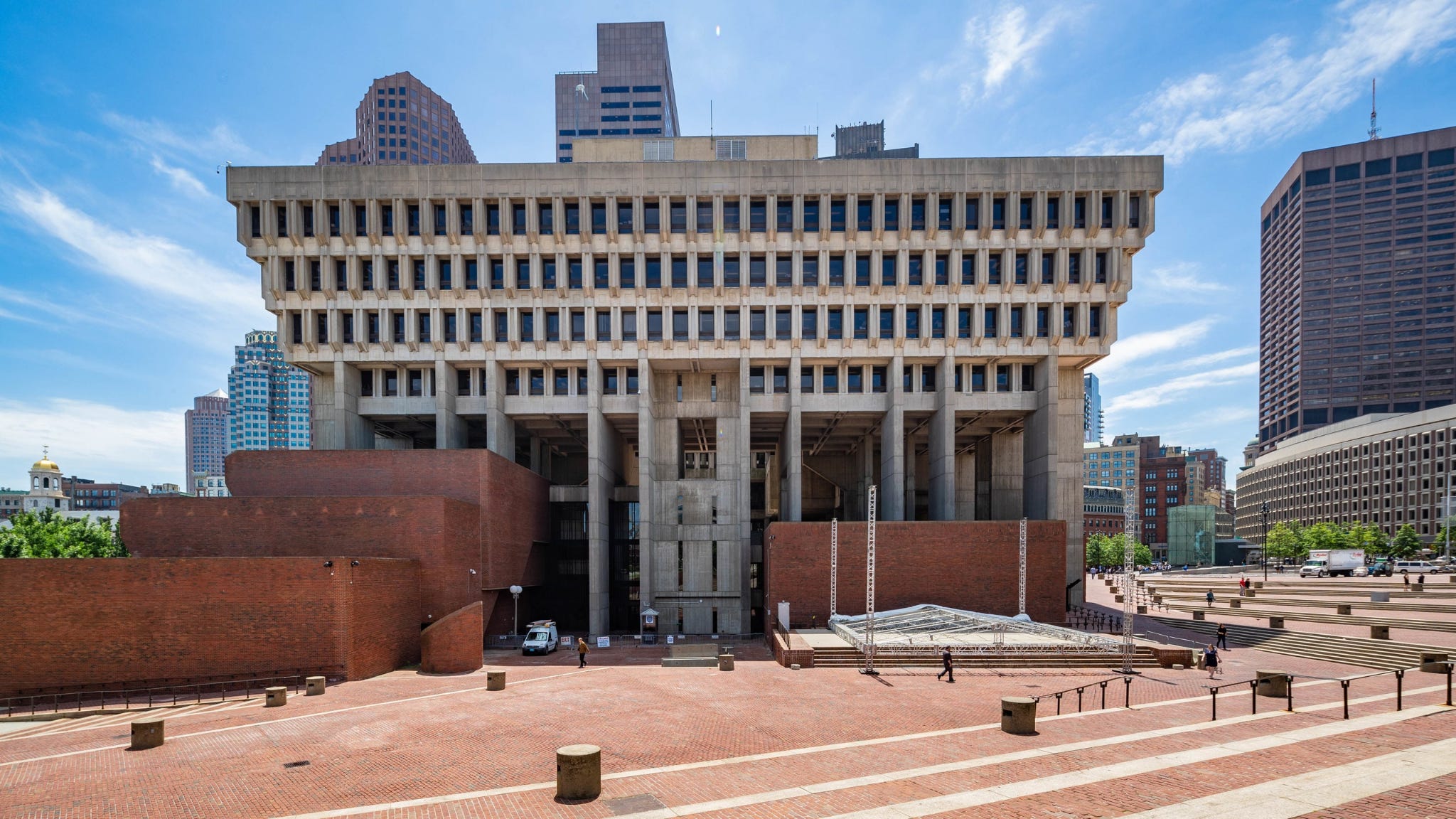
I hate how this building looks. But you know what? It works.
I don’t just mean that it’s stayed upright since 1968 - though, that too. I mean it has a coherent vision. The architects argued its different levels reflect the nesting functions and departments of government1. I’d argue its vision is ‘what if a ziggurat was upside down’.
To my eye, it breaks all the rules of how a beautiful building should look. But that’s what makes it art.
One of the great lies of the internet2 is that, now that we have access to all the information in the world, we can all make masterpieces. We can all write CITIZEN KANE - you just have to know everything about how it was made, and then just…do that! Read these articles and you’ll know it all!
That’s not true.
There’s a whole industry of screenwriting websites and podcasts and advice blogs3, and there’s a lot to learn from all of them - lots of rules and best principles. But, as writers, we need to be willing to break the rules, rather than slavishly following things we’re taught. Writing is magic, animation, summoning - not math.
Let’s look at a movie I love that shouldn’t work at all.
SWISS ARMY MAN is the tale of a suicidal man marooned on an island who discovers a farting corpse that becomes his best friend. The corpse, played by Daniel Radcliffe, can talk, and the marooned man, played by Paul Dano, rides him like a jet-ski across the ocean4.
Oh, and his erections work as a compass.
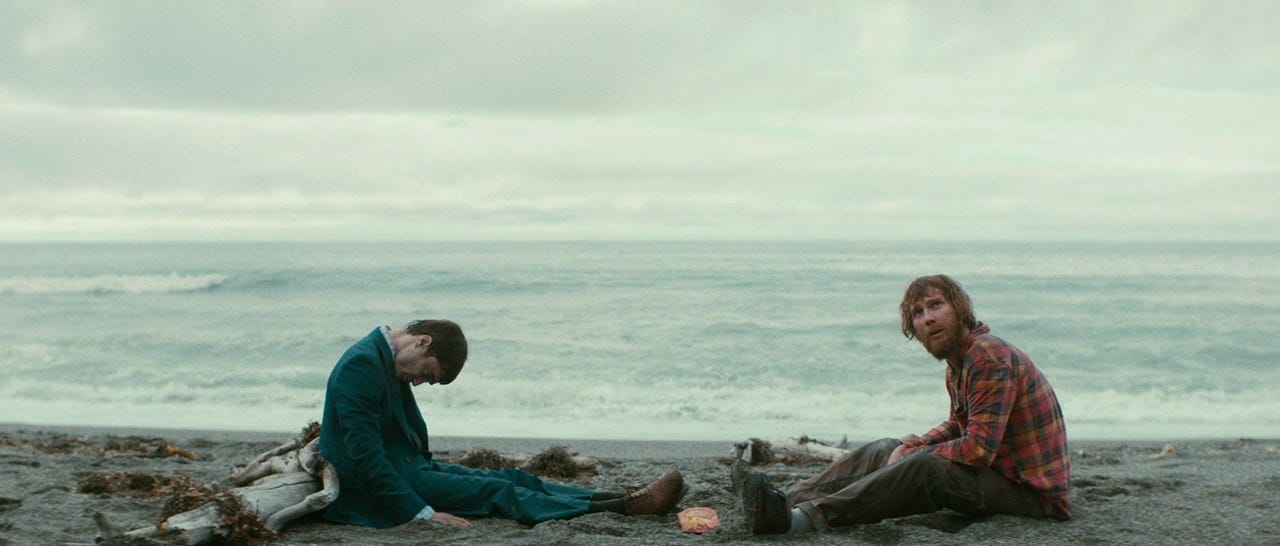
This is a very bad idea. But it works great.
There’s not a single screenwriting principle SWISS ARMY MAN doesn’t ignore. Logic changes willy-nilly. Most of the plot is driven by deus ex machina, pushed forward by some magic power the corpse just suddenly has. It walks one of the weirdest tonal lines ever - the directors wanted the first fart to make you laugh, and the last fart to make you cry.
And they fucking do.
At the end of the day, our job as writers is to build something. You need to know how load-bearing walls work. You need to know where to pour foundation. But you also need to say ‘fuck it, what if it was all elevator shafts?’. That’s why it’s architecture and not construction. That’s why it’s art.
It’s important, as screenwriters, to know the math, to understand principles of plot, character, dialogue etc.5 This Substack exists, in part, to convey my convictions about those principles, ones I’ve honed by reading approximately 1,500 screenplay pages a week for years.
But that doesn’t mean we should be mathematicians. You can’t put principle A and principle B together to make great writing - or great filmmaking, or great architecture. In fact, rule-following writing is usually less than the sum of its parts. When I read a script for The Black List that follows all the rules slavishly…yeah, that’s usually a 5/10 for me.
I guess what I’m arguing for is what a lot of people call soul. Spark, friction, a bit of magic. As I noted in my first essay here, that’s what Méliès says at the end of HUGO that made me devote my life to this racket. “Wizards. Mermaids. Travelers, adventurers…magicians.” We should read all the essays and articles and interviews we can. And then we should go ‘that’s fun - how do I make it work if I ignore that?’.
That, after all, is where the good stuff really lives. Right out there on the edge. Or in whatever secret DR STRANGELOVE lair is at the top of Boston City Hall.
Supposedly the public areas are beneath the mayor’s office, which is beneath the bureaucracy. I think that suggests a certain ‘we secretive elite loom above you’ thing, but maybe I’m just halfway through the new Pynchon novel.
Give me time, the many lies of the internet will become a running theme here…he wrote on the internet.
Many of which are there largely to farm the clicks of aspiring screenwriters for ad revenue. Not this Substack, though! I’m here for subscription pledges. A good time too, but…subscription pledges.
I saw SWISS ARMY MAN at the Cinerama dome after a Q&A with the directors and Paul Dano. Daniel Radcliffe wasn’t there, so they brought out a dummy they used for stunts and asked it questions.
For those following along from other disciplines, I’d say the same thing is true of blocking, color, movement for directors, fermentation, shaping and scoring for bakers etc.