

A Screenplay Is A Theme Park
Show, don’t tell. Also: maybe don’t show everything?
I talk a lot about different art forms here - music, comic books, architecture. One of the reasons I do that is because I’m tired of movies inspired solely by movies - the weird ouroboros autosarcophagy of movies that don’t contain a shred of personal experience.
The other reason is that I think we can learn a lot about our art form by studying others. We ought to think about what a screenplay can do that a painting can’t, or what a screenplay can’t do that a song can. The best way to understand the medium we’ve chosen to work in is to study the mediums we haven’t.
I love this piece by Rebecca Makkai - You’re Writing a Book. So Stop Writing a Movie - for exactly that reason, for all its exploration of what books can do that movies can’t, and vice versa. This is the kind of comparison we can learn so much from - and it made me think about what both mediums are especially good at. What do they share?
Here’s a pitch. The novel and the screenplay are mediums of immersion.
When you’re reading a novel, you stop time - there’s that wonderful moment where you look up at the clock a hundred pages later and realize you’ve lost an hour. Sound too - you stop listening to every creak of the floorboard or chirp of birds or snore of your sleeping partner. You become completely immersed.
I think the same thing should be true of the screenplay. There’s no reason it couldn’t. And yet, I so rarely read scripts that try for that. A screenplay should be a sensory experience that sucks you up and makes itself the only thing you can focus on. It shouldn’t be something you just read.
A screenplay isn’t a textbook, I’m saying. It’s a theme park.
I find, unfortunately, that most of the scripts I read exist to tell me something. It could be a moral or a message or a character’s traumatic backstory. And there’s nothing wrong with including any of those things in your script - lots of great movies do.
But there is something deeply wrong with telling them to me.
I hate writing that talks down to its audience, as if they’re dumb little babies who can barely follow a plot. Telling - simply explaining something, rather than showing it - feels like that to me. It feels like you think your audience are morons.
Plus, if a scene description just says ‘Sheila recalls her father’s drinking’ or ‘Unbeknownst to Ron, there’s a secret passage behind the bookshelf’…what value is that? The audience of a finished film wouldn’t know any of that - they didn’t read the script. And it flattens the scene out - it makes it less dynamic and visual.1
But if you show me something? If, to use the old example, you don’t tell me the moon is shining but you show me the glint of light on a broken glass? Well, suddenly, you can see the movie in your head. Suddenly, you’re on a journey.
A film is something you live through - an experience, not a presentation. No one talks back to a PowerPoint. People feel compelled2 to talk back to the screen.
This is what Rian Johnson said about KNIVES OUT:
“Yeah, maybe there’ll be a twist, maybe you’ll guess who did it, maybe not. That’s kinda not what’s important here. We’re gonna go on a ride. [...] A rollercoaster, not a crossword puzzle, was kinda my goal-post.”
Of course, this doesn’t mean you need to show everything. I see script after script that notes the exact make and model of a character’s gun. Most of the time I end up thinking this:
So? It’s a revolver, right?
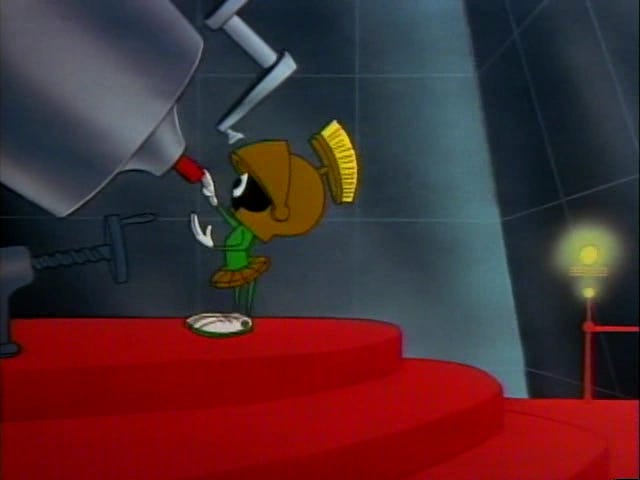
And it isn’t just guns - his shirt is lilac and they like gin but not whiskey and she has a birthmark on the small of her back that we’ll never see. I’m being shown a lot - but what does any of that add to the script? Does it tell me something about the character, does it matter to the plot? Why is it there if it doesn’t add anything?
I bring this up not just to gripe about things that annoy me.3 I bring it up because I think it illustrates something else our medium is particularly good at: Suggestion. Inference.
The best moments in a screenplay are when someone reveals some little hint of something - a tip of ice - and suddenly we realize a whole iceberg’s worth of information. Take this coffee cup:
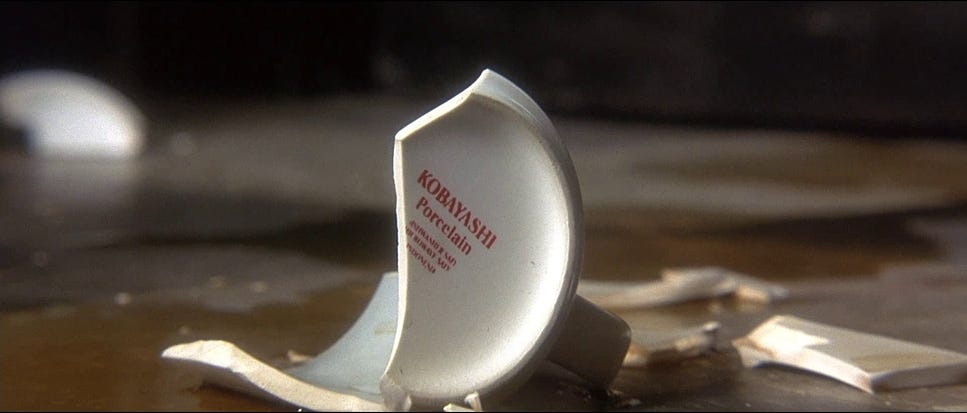
That one detail conveys the reveal of THE USUAL SUSPECTS better than any monologue ever could. And that whole realization sequence? Less than a minute of screen time. A sharp script doesn’t belabor the point. It shows us - doesn’t tell us - something small, just whatever’s necessary. And then it lets us realize a world of implications ourselves.
So, yes, a screenplay is a theme park. But it’s really the blueprint to a theme park. It has all the details that summon up that park, all the plans and layouts. The only things on it are necessary. Maybe it doesn’t matter that most of the guests are wearing New Balances.
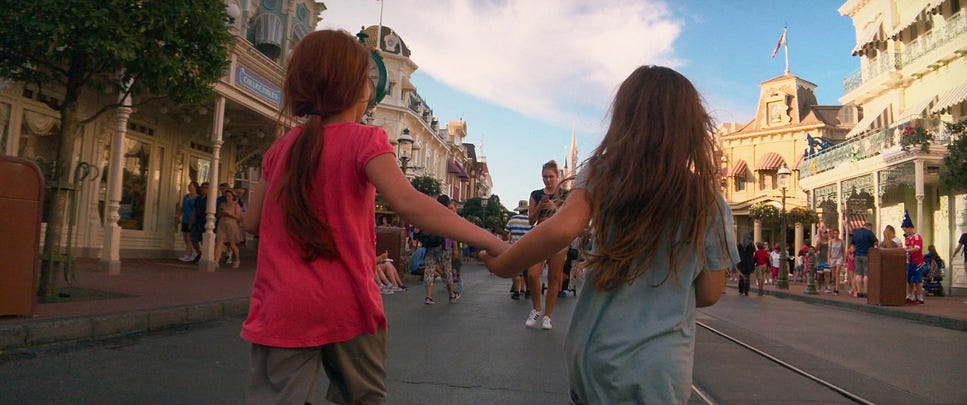
Cinema is experiential rather than explanatory. You connect to it because you feel you’re living through something alongside the characters. A screenplay ought to be the same, something you can lose yourself in.
Show, don’t tell - it’s an old chestnut, we’ve all heard it. But I think this is the larger purpose of it. Why should we show rather than telling? It’s to make sure the script becomes something you live through, something you enter, rather than something you pick up and put down.
A screenplay, like a movie, only has sound and image at its fingertips. I cannot tell you how many screenplays I’ve read that say things like ‘The room smells like butternut squash’. I mean, sure, but…this is a movie. And you may be having a stroke.
Even though we wish they wouldn’t!
That’s why I have a Substack, obviously.
Just finished a book by Alan Leavy. It’s called Theo of golden. I am not recommending the book. It goes on the way too long. But the language, his descriptions are succinct and worth just reading a chapter or two of the book.